
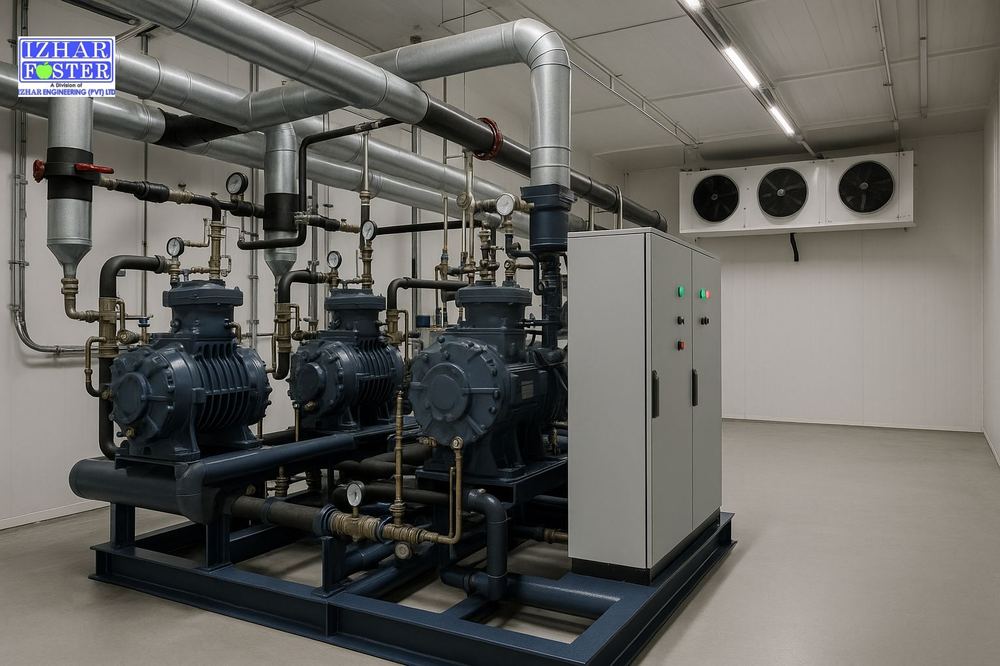
A refrigeration plant is the engine room of any cold store, blast freezer, CA store, or distribution hub — and engineering one for Pakistan is genuinely harder than most international catalogues admit. Lahore and Multan touch 50 °C in summer. Karachi runs at 42 °C with 80% relative humidity from May to September. The grid drops voltage when it's hottest. Load-shedding still happens. Coastal air carries salt that eats fin coils. Condensers catch dust. None of those conditions appear on the rating plate of a European or Chinese compressor — and ignoring them is the most common reason refrigeration plants in Pakistan run 30–40% below catalogue capacity right when product is most at risk.
Ammonia or Freon — choosing the right refrigerant
The first decision on any cold-storage project in Pakistan is the working fluid. There is no universal answer; the right choice depends on capacity, application, operator skill, and regulatory environment.
When to use ammonia (NH₃)
Ammonia is the thermodynamic gold standard for large industrial loads — typically anything above 500 kW of refrigeration. Pakistan's biggest meat processors in Lahore, Faisalabad, and Karachi run ammonia. Major distribution hubs on Lahore Ring Road and the Karachi M-9 corridor run ammonia. Ice plants and large blast-freezer lines for seafood export at Karachi Fish Harbour and Korangi Fish Harbour run ammonia. The economics are unbeatable at scale: ammonia has zero ozone depletion potential, zero global warming potential, no F-gas regulatory burden, and 15–20% lower energy cost over a 20-year operating window than equivalent Freon plants.
What you give up: complexity. Ammonia plants need certified operators (and Pakistan has a small but growing pool of them), provincial EPA NOCs above threshold capacity, dedicated machine rooms with proper ventilation, and engineering rigour around safety relief and detection. None of these are unmanageable — but they are real costs that small commercial projects do not justify.
When to use Freon
For under-25 HP commercial loads — pharmaceutical cold storage in Lahore, Karachi, and Islamabad pharma clusters; supermarkets and modern retail backstores; mid-sized cold storage for fruit, vegetables, dairy; restaurant freezers and medical-grade storage — modern Freon systems are simpler, faster to commission, easier to service, and have spare parts available in every city in Pakistan. Refrigerant supply is mature: R134a, R404A, R407C, R410A, and R507 are all widely stocked. R22 is still supported on legacy plants but is actively being phased out — DRAP, EPA, and Customs have all stopped fresh R22 imports under Montreal Protocol obligations, so any new plant should specify a non-HCFC refrigerant.
The full refrigeration systems page covers Freon HP capacity tiers, refrigerant selection by application, and the three ammonia system architectures.
Three ammonia architectures, three different applications
Ammonia is not one system — it's a family of architectures, each suited to a specific kind of facility.
Ammonia Direct Expansion (DX)
Liquid ammonia is metered directly into evaporator coils inside the cold room, where it boils and absorbs heat. Compact, cost-effective, and simple — the right choice for single-temperature industrial freezers without occupancy concerns. Common in Pakistani meat-processing plants and large distribution-warehouse freezer cells.
Ammonia Pumped Circulation
A recirculation pump moves liquid ammonia through evaporators at high flow rates. Only a portion evaporates (wet return); the remainder flows back to a low-pressure receiver. Vapour returns to compressor; liquid is pumped back to evaporators. The architecture delivers uniform cooling across very large spaces — exactly what blast-freezer lines for poultry, beef, and seafood, and big multi-zone distribution warehouses, need. Several of Pakistan's largest cold-storage operators run pumped-circulation ammonia for this reason.
Ammonia–Glycol Indirect
Ammonia stays in the machine room. Inside that room, ammonia cools a secondary fluid — typically glycol — in a plate heat exchanger. Chilled glycol is then pumped to air coolers in the cold rooms. The ammonia cycle never enters product zones, dramatically reducing leak risk in occupied or sensitive areas. This is increasingly the architecture of choice for Pakistani DRAP-validated pharmaceutical cold storage (where ammonia in product zones is not acceptable), dairy plants, and multi-zone food-processing facilities. Higher capital cost than DX, but lower operational risk and easier compliance.
Sizing for 50 °C — Pakistan's silent capacity killer
Catalogue capacity for almost every compressor and condenser sold in Pakistan is rated at 35 °C ambient. That number reflects European, North American, and East Asian operating conditions — not Pakistani ones. Lahore, Multan, Faisalabad, Bahawalpur, and Sukkur regularly hit 48–50 °C from late May through July. Karachi runs cooler in absolute terms (42–43 °C peak) but adds 70–85% relative humidity, which inflates condenser load through latent heat.
Use these derate factors when sizing condensers for Pakistani conditions:
- Medium-temperature plants (+2 to +5 °C): derate condenser capacity by 2.0% per °C above the 35 °C catalogue point.
- Low-temperature plants (−18 to −25 °C): derate by 2.7% per °C — the temperature lift is bigger, so the penalty is steeper.
- Hard floor: never assume more than 60% of catalogue capacity at design ambient.
Worked example. A 100 kW catalogue condenser in Lahore sized only for 35 °C will deliver roughly 70 kW at 50 °C ambient on a low-temperature freezer plant — a 30% capacity loss on the day your cold store is at peak load. Over-sizing the condenser by 30–40% adds maybe 10–15% to the refrigeration line item but eliminates the entire summer reliability problem. Our condenser sizing tool applies these derates automatically.
Engineering for the Pakistani grid
Pakistani industrial power is real, but it is not always reliable. Voltage swings of ±10% from nominal are routine. Load-shedding still affects industrial feeders in many cities — sometimes scheduled, sometimes not. Three engineering responses are non-negotiable for any new refrigeration plant:
1. Generator backup sized for the full plant
Not just lights and controls — the full compressor, fan, and pump load. Rough sizing for greenfield projects:
- 2,000 m³ medium-temp cold store (+2 to +5 °C, single-zone): 75–110 kVA standby
- 4,000 m³ low-temp freezer (−18 to −25 °C): 200–280 kVA standby
- 8,000 m³ multi-temperature DC (mixed): 400–550 kVA standby
Add 25–35% headroom for compressor inrush at restart. Auto-transfer switching between grid and generator should engage within 5 seconds; longer delays risk thermal excursion in low-temp freezers.
2. Soft-start or variable-frequency drives
Direct-online start of a 50 HP compressor on a marginally-sized generator will trip the genset's own protection. Soft-start motors and VFDs flatten the inrush, protect the generator, and have a useful side benefit on the grid side: reduced strain on transformers during start-up. The capital premium is small relative to the operational consequence of a generator that trips out at 11 PM and doesn't restart until morning.
3. Panel insulation thick enough to absorb outages
The cold store envelope is the buffer between your product and grid failure. PIR sandwich panels at 100 mm for medium-temp and 150 mm for low-temp give roughly 30–60 minutes of thermal grace before product temperature begins to drift, depending on door discipline and ambient. A poorly-insulated cold store needs a perfect grid; a well-insulated one survives Pakistani reality.
Coastal air, dust, and condenser fouling
Two Pakistani conditions degrade refrigeration plants faster than the textbooks expect. Coastal salt-laden air at Karachi, Port Qasim, Gwadar, and Pasni corrodes copper-aluminium condenser fins within 18–24 months unless coil coatings (e.g., epoxy or hydrophobic polymer) are specified upfront. Sealed-tube or all-aluminium MicroChannel condensers are an alternative for severe coastal exposure.
Inland plants face a different problem: dust loading. Faisalabad, Multan, Bahawalpur, and the wider Punjab agricultural belt run dusty during harvest seasons. Condenser coils foul fast — a 30% airflow restriction from caked dust raises head pressure, drops capacity, and can trip high-pressure cutouts on hot afternoons. Spec automatic condenser-clean systems for inland plants, or build maintenance routines around weekly fin-comb cleaning during peak dust months.
How much redundancy do you actually need?
The textbook answer is "depends on outage cost." The Pakistani-specific version: it depends on what your customer paid for.
- Pharma cold rooms (DRAP-regulated): N+1 compressor redundancy is the standard. A single thermal excursion above +8 °C can invalidate an entire batch of vaccines or biologics worth crores of rupees. The validation package itself requires documented redundancy.
- Halal-meat and seafood exporters: N+1 is also standard. A single shipment to Saudi Arabia or the UAE can be worth Rs 50 lakh to Rs 5 crore; a freezer failure that warms a container before loading kills the contract and the certification.
- Mid-sized commercial cold storage: Single-train plants with strong service contracts, 24/7 phone support, and on-site spare parts (compressor oil, controllers, contactors, fan motors) are typically sufficient. Add a dedicated standby evaporator only if your product is unusually sensitive.
- CA stores: The atmosphere control kit is the unique-spare item. Refrigeration redundancy follows the same logic as commercial cold storage; atmosphere generators and scrubbers should always have spare modules on site.
Remote monitoring is now standard
Cloud-connected monitoring of suction pressures, discharge pressures, evaporator temperatures, room temperatures, runtime hours, and energy consumption used to be a premium feature. In 2026 it is expected — particularly for any pharma facility going through DRAP audits and for institutional buyers who require continuous temperature logs as part of their procurement contracts. Even a small commercial cold store benefits: a 2 AM SMS alarm to a service engineer the moment a high-pressure cutout trips can save the entire load before product is damaged.
The bottom line for Pakistani operators
Refrigeration is the most expensive, most consequential, and most under-specified part of most cold-storage projects in Pakistan. The same plant designed by an experienced Pakistani engineering team — one that knows the grid, the climate, the dust, and the coastal salt — versus an off-the-shelf catalogue specification will run 20–35% more efficiently, last twice as long, and survive failure modes the catalogue version cannot.
If you're sizing a plant for a project in Pakistan, talk to our engineers. We work to ASHRAE methods cross-checked against Heatcraft, Copeland, and Bitzer software — but we apply the derates, the redundancy, and the genset specs that match the actual conditions your plant will face. Our load calculator, condenser sizing, and refrigerant charge tools are open and free — start there if you want to size a project before requesting a quote.