
Pharmaceutical Cold Storage in Pakistan — GMP cold rooms and pharma warehouses for biologics, vaccines, and the full +25°C to −80°C spectrum
Izhar Foster designs and validates pharmaceutical cold storage across Pakistan — from +25°C ambient CRT pharma warehouses through +2/+8°C refrigerated cold rooms (the largest pharma class: vaccines, insulins, biologics, injectables) and down to −20°C deep-freeze and −80°C ultra-low. Every project ships with DQ/IQ/OQ/PQ documentation, WHO TRS 961 Annex 9 mapping, MKT excursion analysis, N+1 redundant Bitzer-based refrigeration, tamper-evident continuous data logging, and DRAP-audit-ready packages. Built since 1959 from a 277,460 sqft Lahore plant for pharma manufacturers, distributors, hospitals, and Pakistan's vaccine programs.
Getz Pharma · Sami Pharmaceuticals · Searle Pakistan · USAID/EPI vaccine programmes
1959 · 277,460 sqft plant
2,100+ delivered nationwide
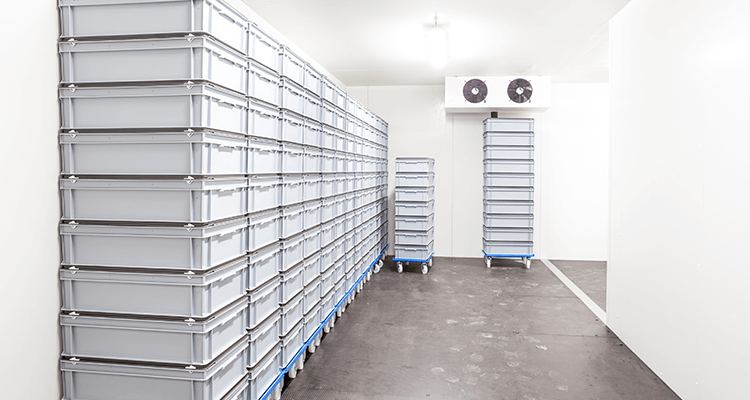
Pharmaceutical cold storage isn't a smaller version of food cold storage. It's a different engineering discipline — defined by tighter tolerances, redundant systems, and validated documentation that is non-negotiable in front of a DRAP auditor or an export-market QC team. A single excursion event on a single batch of vaccines, biologics, or temperature-sensitive injectables can cost more than the entire refrigeration plant. The economics of "good enough" don't apply.
Izhar Foster delivers pharmaceutical cold storage and cold room solutions across Pakistan for the full pharma temperature spectrum — from +25 °C ambient pharma warehousing, through +2/+8 °C refrigerated storage (the largest product class), down to −20 °C deep-frozen biologics and −70 to −80 °C ultra-low for mRNA vaccines and specialty biologics. Every room ships with the validated commissioning package your audit cycle and your insurer demand.
The five engineering requirements unique to pharma cold storage
What separates a pharmaceutical cold room from a commercial chiller comes down to five non-negotiables:
- Tighter temperature band. Commercial chillers operate at ±2 °C; pharmaceutical cold rooms hold ±0.5 °C across the entire validated working volume. Achieving that requires panel thickness one or two SKUs above commercial spec, evaporator design that prevents stratification, and air-distribution patterns mapped before commissioning.
- Continuous tamper-evident data-logging. Temperature must be logged at minute-or-better intervals, written to non-volatile media, and protected against alteration. Auditors look for unbroken records over 12+ months. Modern systems write to encrypted local storage plus cloud, with hashed records that can't be silently amended.
- N+1 redundant refrigeration (zero single points of failure). Two compressors, sized so the secondary alone carries the full load. Auto-transfer on primary failure inside 30 seconds. For high-value applications, N+2 (two backups) and dual independent refrigeration circuits.
- Validated commissioning (IQ / OQ / PQ). Installation Qualification documents that the equipment installed matches the design specification. Operational Qualification proves it operates within validated parameters. Performance Qualification proves it operates correctly with actual product loaded. None of these are optional for GMP-compliant operation.
- Power redundancy. UPS for monitoring and controls (so logging never gaps), plus a dedicated backup generator sized for the full refrigeration load with automatic transfer switch (ATS). Pakistani grid outages cannot become temperature excursions.
Temperature classes we deliver
| Class | Range | Typical product | Our spec |
|---|---|---|---|
| Ambient pharma | +15 → +25 °C | Tablets, capsules, most OTC | 75–100 mm panels, controlled humidity |
| Refrigerated (largest class) | +2 → +8 °C | Vaccines, biologics, insulins, many injectables | 100–125 mm panels, ±0.5 °C, N+1 |
| Deep-frozen biologics | −20 °C | Plasma, certain biologics, master cell banks | 125–150 mm panels, dual circuits |
| Ultra-low | −70 → −80 °C | mRNA vaccines, specialty biologics, research | 150–200 mm panels, cascade refrigeration, N+2 |
Sizing for any of these starts with the cold room heat load calculator — pharma applications particularly benefit from precise sizing because oversized refrigeration on a tight-band room cycles excessively and degrades temperature stability.
The validated commissioning workflow
Pharmaceutical cold storage commissioning follows a structured path that produces audit-ready documentation at every stage:
1. Design Qualification (DQ)
Before any equipment is ordered, the design itself is validated against the User Requirement Specification (URS). The DQ document captures the temperature class, redundancy requirements, capacity, validated working volume, controls philosophy, and alarm strategy. Auditors verify the design intent before installation begins.
2. Installation Qualification (IQ)
Once installed, the IQ confirms that what was actually installed matches the DQ — equipment serial numbers, refrigerant charge, panel manufacturer certificates, sensor calibration certificates, drawings as-built, electrical commissioning records.
3. Operational Qualification (OQ)
Equipment is run empty across its full operating envelope. We test refrigeration performance at design ambient, defrost cycle behaviour, alarm trigger thresholds, primary-to-backup compressor changeover time, controls response, and recovery time after door-open events. The OQ report typically runs 80–120 pages.
4. Performance Qualification (PQ) and mapping study
The room is loaded with product (or product simulant) and held under realistic operating conditions for 24–72 hours while temperature is logged at multiple validated sensor points. The thermal mapping study identifies hot spots, cold spots, and worst-case locations. The PQ report documents that the room maintains validated band uniformly across the loaded volume.
Re-qualification cadence
Most pharmaceutical operators re-qualify cold rooms annually through abbreviated mapping and OQ checks, with full PQ on a 3-year cycle or after any significant equipment change. We provide re-qualification services on existing rooms (ours and others') across Pakistan.
Mean Kinetic Temperature (MKT) in pharmaceutical cold storage
Mean Kinetic Temperature (MKT) is the single equivalent temperature that — if maintained for the same period — would produce the same degradation effect as a series of varying-temperature excursions. It is required by WHO TRS 961 Annex 9 for excursion assessment and is calculated using the Haynes equation (J. Pharm. Sci. 60(6), 1971):
TMKT = −ΔH ÷ R ÷ ln[(e−ΔH/RT₁ + e−ΔH/RT₂ + … + e−ΔH/RTₙ) ÷ n]
Where: ΔH = activation energy (typically 83.144 kJ/mol per ICH Q1E); R = 8.314 J/mol·K (gas constant); T₁…Tₙ = measured temperatures in Kelvin for each time interval; n = number of intervals. A correctly designed and operated +2/+8 °C cold room holds MKT below 8 °C across the entire storage period. Izhar Foster provides MKT calculation reports from continuous data-logger output as part of the PQ documentation package.
WHO PQS vaccine cold storage
The WHO Performance, Quality and Safety (PQS) catalogue (document E003) defines minimum performance requirements for refrigerators and freezers used in vaccine programmes — including cold rooms and walk-in cold rooms (WICR). For vaccine programmes in Pakistan, including the Expanded Programme on Immunisation (EPI) managed under the Ministry of National Health Services, cold room procurement must comply with WHO PQS E003 specifications. Key requirements in E003 for walk-in cold rooms: minimum hold-over time of 48 hours after loss of power (validated at maximum ambient), temperature uniformity within ±1 K at all measurement points, alarm activation within 30 minutes of temperature breach, remote alarm capable of alerting off-site staff. Izhar Foster designs and supplies WHO PQS-class cold rooms for vaccine storage and has supplied vaccine-chain infrastructure for USAID and Pakistan government programmes.
Temperature excursion response protocol
Under DRAP Good Storage and Distribution Practices (GSDP) — referenced in Statutory Regulatory Order (SRO) 150(I)/2016 — a written excursion response procedure is mandatory for licensed pharmaceutical storage facilities. An excursion is any deviation outside the validated storage band (e.g., above +8 °C for a +2/+8 °C room) for any recorded duration. The response protocol must include: (1) immediate notification to QA, with timestamp; (2) product quarantine pending MKT impact assessment; (3) MKT calculation using all logger data from the preceding storage period; (4) formal impact assessment by a qualified person — decision to release, retest, or destroy; (5) root-cause investigation and corrective and preventive action (CAPA) documentation; (6) update to the temperature deviation log; (7) regulatory notification if the deviation exceeds DRAP-specified thresholds for controlled drugs or vaccines. Izhar Foster provides a template excursion-response SOP as part of every IQ/OQ/PQ documentation pack — formatted to DRAP GSDP requirements and referencing the specific cold room serial number and sensor calibration records.
Pharma-specific design choices that matter
Beyond the documentation, the physical design of a pharmaceutical cold room differs in detail from a commercial cold store:
- Panel thickness one tier above commercial. Where a +4 °C dairy chiller might use 80 mm panels, a +2/+8 °C pharma room uses 100–125 mm to maintain band even during door-open events.
- Anti-microbial wall finishes and easy-clean coving. Where panel-to-floor and panel-to-ceiling joints meet, coved transitions allow proper cleaning. Wall finishes are food-grade or pharma-grade hygiene-rated.
- Sealed penetrations. Cable entries, refrigeration penetrations, drainage — all sealed with documented materials. Class compliance for cleanroom-adjacent applications is verified at handover.
- Run-and-standby evaporator coils. A second evaporator that takes over if the primary develops a fault. For high-value rooms, this is now standard.
- Dual independent temperature sensors. One drives controls, one drives alarms — neither can fail silently without alerting the operator.
- Heated frames on every door at any sub-ambient temperature — gasket integrity is the first thing to fail in a poorly-specified pharma installation. See insulated doors.
DRAP and Pakistani regulatory touchpoints
Pakistan's Drug Regulatory Authority (DRAP) operates under the Drug Act 1976 and the DRAP Act 2012. For pharmaceutical cold storage and warehousing, the applicable touchpoints are:
- DRAP Good Storage and Distribution Practices (GSDP) — temperature control, logging, validation, and re-qualification expectations
- WHO TRS 961 Annex 9 — model guidance on storage and transport of time-and-temperature-sensitive pharmaceutical products (TTSPPs), referenced by DRAP
- WHO TRS 957 Annex 5 — supplementary guidance on temperature mapping
- ISO 5149-1 — refrigerating systems and heat pumps, safety
- Pakistani GMP regulations — for facilities engaged in pharma manufacturing
For export-oriented pharmaceutical operators, additional standards apply depending on destination market — EU GDP, US FDA-FSMA, GCC GHC standards. Our documentation packages can be formatted to align with any of these on request.
What a DRAP auditor checks in your cold room
A DRAP inspection of pharmaceutical cold storage covers the following items in sequence. Prepare documentation for each before the audit date:
- Temperature band validation. The auditor reviews your PQ mapping report to confirm the validated working volume maintains ±0.5 °C across all sensor positions for the full product load.
- Data-logger calibration certificates. All temperature sensors must have traceable calibration certificates (PNAC-accredited or equivalent) dated within 12 months.
- Continuous data records. Unbroken logging at ≤5-minute intervals over the past 12 months. Gaps, missing data, or manual entries without authorised explanation are findings.
- Alarm and deviation log. Every alarm event must be logged with cause, duration, product impact assessment, and corrective action. Unrecorded excursions are critical observations.
- Equipment maintenance records. Compressor, condenser, evaporator, door gaskets. Predictive maintenance intervals documented and followed.
- SOP for temperature excursions. A written procedure stating what to do if temperature goes out of range — who is notified, how product is quarantined, who authorises release or destruction.
- Power redundancy test records. Documented annual (minimum) generator transfer test showing ATS activated within the specified time and refrigeration maintained through the event.
- Re-qualification status. Last full PQ date. Abbreviated mapping dates. Any significant equipment changes triggering re-qualification.
Izhar Foster's delivered commissioning package covers all 8 items at handover. Re-qualification services available annually.
The pharmaceutical cold chain — what it is and why every link matters
The pharmaceutical cold chain is the uninterrupted system of temperature-controlled storage, handling, and transport that keeps a temperature-sensitive medicinal product within its validated thermal band from the moment of manufacture to the moment of administration to the patient. For vaccines, biologics, insulins, monoclonal antibodies, and many advanced therapy medicinal products (ATMPs), there is no recovery from a single broken link: a 90-minute excursion in a Karachi customs warehouse can render an entire shipment unsaleable, even if every other handler in the chain performed perfectly.
In Pakistan, where ambient temperatures reach 48 °C across Sindh and southern Punjab in summer, the pharma cold chain is not a "nice-to-have" specification — it is the difference between a product that meets DRAP release criteria and a write-off. The economics are unforgiving. A typical 1,000-litre shipment of mRNA vaccine product can carry a wholesale value of PKR 600 million to PKR 1.2 billion. The refrigeration plant that protects it is a small fraction of that value.
The five links in a pharmaceutical cold chain
- Manufacturing-site storage. Validated +2/+8 °C, −20 °C, and where required −80 °C cold rooms inside the GMP-licensed facility. This is where the bulk product, finished goods, and reference standards live before despatch. Engineering: tight band (±0.5 °C), N+1 redundancy, validated mapping, tamper-evident logging, IQ/OQ/PQ documentation.
- Refrigerated outbound vehicles. GDP-validated trailers and rigid trucks at the loading dock of the GMP cold room. Pre-cooled before loading, with continuous data-logging that hands over to the receiving warehouse without a temperature gap. See refrigerated vehicles.
- Distributor and 3PL warehouses. Provincial pharmaceutical distribution hubs — typically 500 to 3,000 m³ +2/+8 °C cold rooms, often with adjacent CRT (+15/+25 °C) ambient pharma warehousing. These are the bottleneck in most Pakistani cold chains because they handle the highest throughput per cubic metre.
- Last-mile transport. From distributor to retail pharmacy or hospital — typically refrigerated vans or insulated active containers. Excursions are most frequent in this leg because of multiple door-open cycles and short transit windows.
- Point-of-care storage. Retail pharmacy fridges, hospital pharmacy walk-ins, vaccination centre cold rooms. The smallest cold storage units in the chain but the most numerous — and the least monitored without standardised logging infrastructure.
Izhar Foster engineers links 1, 3, and 5 — manufacturing-site GMP cold rooms, distributor and 3PL pharmaceutical warehouses, and point-of-care walk-in pharmacy cold rooms. We provide the validated outbound interface at the loading dock (link 1 → link 2) and the validated receiving dock at the distributor (link 2 → link 3). Refrigerated trailers and last-mile vehicles are typically supplied by specialist cold-chain logistics operators such as Connect Logistics, who pick up validated product from our cold rooms.
Why the pharmaceutical cold chain matters more in Pakistan than in temperate markets
Three factors make Pakistani pharmaceutical cold chain engineering materially harder than the European or North American equivalent:
- Design ambient. Lahore, Multan, and Karachi all see 45–48 °C peak ambient. ASHRAE 0.4 % design day for Lahore is 44.5 °C dry-bulb. European pharma cold rooms are typically designed for 32 °C peak ambient. Refrigeration plant sized for European conditions will derate by 18–22 % in Pakistani summer — a recipe for excursions exactly when ambient is most punishing.
- Grid reliability. Even in Lahore Industrial Estate and SITE Karachi, LESCO and K-Electric load-shedding combined with feeder faults produce 200–400 outage minutes per month. Pharmaceutical cold storage in Pakistan is not optional for backup power — it is mandatory. UPS-protected controls, dedicated genset with ATS sized for full refrigeration load, and validated annual transfer testing are all minimum specifications.
- Regulatory weight. DRAP inspections under SRO 150(I)/2016 are documentation-heavy and finding-conservative. The audit risk attached to a temperature deviation is regulatory, commercial, and reputational. A DRAP Form 5 deficiency for cold-chain failure can suspend distribution licences pending corrective action.
These three conditions are why Izhar Foster's design ambient default is 46 °C, why we install N+1 minimum on every pharmaceutical cold room regardless of size, and why our IQ/OQ/PQ packages are formatted directly against DRAP GSDP inspection checklists rather than against generic WHO templates.
Pharmaceutical cold storage manufacturer in Pakistan — what we build and how we build it
Izhar Foster is the largest pharmaceutical cold storage manufacturer in Pakistan, manufacturing FireSafe PIR sandwich panels in-house from a 277,460 sqft Lahore plant since 1959, and integrating turnkey GMP cold rooms with redundant Bitzer-based refrigeration plant. We are not a reseller. We are not an import-and-assemble integrator. The panel that forms the envelope of your pharmaceutical cold room is manufactured under one roof with the refrigeration plant that serves it, the insulated door that seals it, and the data-logging system that documents it.
What "pharmaceutical cold storage manufacturer" means in practice — and what to ask any competing supplier:
- Panel manufacturing in Pakistan. Our PIR sandwich panels are manufactured to BS EN 14509 with thermal conductivity λ = 0.022 W/m·K (aged, declared value), fire class B1 to ASTM E84, density 40–45 kg/m³, blown with pentane (HCFC-free, GWP < 25). We hold the only continuous PIR sandwich panel manufacturing line in Pakistan with the certifications that DRAP inspectors recognise.
- Refrigeration plant engineering in-house. Bitzer reciprocating and screw compressors, LU-VE and Heatcraft evaporators, Güntner and Thermokey condensers, Carel and Danfoss controls. We size, select, install, and commission. We are not a panel manufacturer who subcontracts the refrigeration to a third party — a common pattern in Pakistani pharma cold storage that fragments responsibility for IQ/OQ/PQ documentation.
- Validated commissioning under one contract. Single Izhar Foster commissioning team produces the full DQ/IQ/OQ/PQ pack. No third-party validation consultant required. No coordination gap between panel installer and refrigeration commissioning engineer.
- Engineered for Pakistani conditions. 46 °C design ambient default. LESCO/K-Electric grid-quality compensation built into compressor selection. Local spares inventory in Lahore.
- 2,100+ installations since 1959. Including pharmaceutical references with Getz Pharma, Sami Pharmaceuticals, Searle Pakistan, the USAID-funded Pakistan EPI vaccine cold chain, and laboratory-grade work for Haier Laboratory in Lahore.
How a pharmaceutical cold room is manufactured — from panel line to validated handover
- Brief intake and design qualification. Your QA team's User Requirement Specification meets our engineering team. We translate URS into a DQ document: temperature class, validated working volume, redundancy class (N+1 or N+2), panel thickness, door specification, racking philosophy, controls and alarming, and the audit-pack contents. Typical duration: 5–10 working days.
- Panel manufacturing. PIR core is foamed continuously between pre-painted steel facings on our Lahore line. Panel thickness, length, and facing colour are made to order. Manufacturing certificate (mill cert + foam batch traceability) follows each panel into the IQ pack.
- Refrigeration plant procurement. Bitzer compressors, LU-VE evaporators, Güntner condensers — long-lead items ordered in parallel with panel manufacturing. Typical compressor lead time 6–10 weeks. Pakistani import handling and customs clearance built into project plan.
- Civil and site readiness. Your civil team prepares the slab to our drawings. We coordinate but do not contract civil works. Slab flatness, drainage falls, and electrical service capacity are pre-validated before panel mobilisation.
- Panel erection and door installation. Typically 2–3 weeks for a 1,000 m³ cold room. Heated frames installed on every sub-ambient door. Sealed penetrations for refrigeration lines, electrical, and data cabling.
- Refrigeration commissioning. Pull-down testing, pressure-and-leak certification, charge-and-burnish, controls integration. N+1 primary-to-backup compressor transfer testing.
- Validated mapping and IQ/OQ/PQ. 24 to 72 hours of empty-room and loaded-room mapping with calibrated multi-point sensors. PQ report identifies validated working volume, hot spots, cold spots, and the recommended sensor positions for ongoing monitoring.
- Handover. Full DQ/IQ/OQ/PQ documentation pack delivered with the keys. Operator training on controls, alarm management, and excursion-response SOP. Annual re-qualification service offered.
Total project duration from PO to validated handover: 14–20 weeks for a standard +2/+8 °C cold room, 18–24 weeks for ultra-low (−80 °C), 22–28 weeks for multi-zone GMP facilities with adjacent CRT ambient warehousing.
Types of pharmaceutical cold rooms we build
The pharmaceutical industry uses a defined family of cold storage room types, each with its own temperature class, redundancy class, and documentation depth. Izhar Foster builds every type in this family. The table below lists the application, the validated band, and the typical Pakistani capacity range for projects we deliver.
| Cold room type | Validated band | Typical capacity | Primary application |
|---|---|---|---|
| Vaccine cold room | +2 / +8 °C ±0.5 °C | 50 – 3,000 m³ | EPI vaccines, biologics, insulin, injectables. WHO PQS E003-class for vaccine programmes. |
| Pharmaceutical warehouse cold storage | +2 / +8 °C ±0.5 °C | 500 – 5,000 m³ | Distributor and 3PL bulk pharma storage with racking and forklift access. |
| CRT (Controlled Room Temperature) pharma warehouse | +15 / +25 °C ±2 °C | 1,000 – 10,000 m³ | Solid-dose oral and most non-cold-chain pharmaceuticals. Highest-volume class. |
| Pharmacy walk-in cold room | +2 / +8 °C ±0.5 °C | 5 – 50 m³ | Hospital pharmacy, retail chain pharmacy, vaccination centres. |
| Deep-freeze biologics room | −18 / −25 °C ±2 °C | 20 – 500 m³ | Frozen biologics, reference standards, plasma products, oncology cold chain. |
| Ultra-low temperature (ULT) room | −70 / −80 °C ±5 °C | 10 – 200 m³ | mRNA vaccines, cell & gene therapy, specialty biologics. Cascade refrigeration. |
| Clinical-trial / climate chamber | Programmable ±1 °C | 10 – 100 m³ | Stability studies (ICH Q1A R2), accelerated and long-term conditions. |
| Validated reefer dock / staging | +2 / +8 °C ±1 °C | Per project | Loading-dock cold staging zones for outbound vehicle interface, eliminating cold-chain gap at dispatch. |
If your application doesn't map cleanly onto one of these — a controlled-humidity API storage room, an explosion-rated solvent cold storage, a low-RH gelatin capsule room — we engineer it. Specialised rooms add 4–8 weeks to typical lead time and require additional documentation in the URS phase.
WHO GMP and the cold-chain regulatory stack
GMP cold storage (Good Manufacturing Practice cold storage) is pharmaceutical-grade cold storage that meets the documentation and validation requirements of the World Health Organization's GMP framework as implemented locally by DRAP. The phrase "GMP cold storage" is sometimes used loosely in the Pakistani market to mean any cold room with a temperature display — that is incorrect. A GMP cold room must demonstrate, through documented evidence, that:
- The temperature band is held across the validated working volume of the room, not just at the wall-mounted display sensor (PQ mapping evidence required).
- The refrigeration system has documented redundancy with verified primary-to-backup transfer (OQ evidence).
- The data-logging system is tamper-evident, with calibration certificates current to within 12 months, and electronic records meet 21 CFR Part 11 audit-trail principles where exported to regulated markets.
- The room has a written, approved temperature-excursion SOP referencing specific equipment IDs.
- Re-qualification is performed on a defined cadence (annual full PQ or abbreviated mapping plus change-control-triggered re-qualification).
- All commissioning evidence (DQ, IQ, OQ, PQ) is archived in a controlled documentation system accessible to DRAP auditors on request.
The applicable regulatory references for pharmaceutical cold storage in Pakistan are:
- WHO TRS 961 Annex 9 (2011, updated) — Model guidance for storage and transport of time- and temperature-sensitive pharmaceutical products. The foundational technical reference.
- WHO TRS 957 Annex 5 — Supplementary guidance specifically on temperature mapping of storage areas.
- WHO PQS specification E003 — Performance, Quality and Safety standard for vaccine cold rooms and freezer rooms. The reference standard for any Pakistan EPI-related installation.
- DRAP Good Storage and Distribution Practices (GSDP) referenced under SRO 150(I)/2016 — the locally enforceable framework.
- Pakistan Drugs (Licensing, Registering and Advertising) Rules — covering distribution licensing, including cold-chain infrastructure requirements.
- ICH Q1A (R2) — Stability testing of new drug substances and products, for any climate chamber or stability-study cold room.
- 21 CFR Part 11 — Electronic records and signatures, where products are exported to US-FDA-regulated markets.
- EU GDP Guidelines (2013/C 343/01) — Good Distribution Practice, for products exported to European markets.
Izhar Foster's IQ/OQ/PQ packages are formatted against DRAP GSDP as primary, with cross-references to WHO TRS 961 Annex 9, WHO PQS E003 (where vaccine-relevant), and ICH Q1A (where stability-study-relevant). For export-oriented operators, additional formatting against EU GDP or US 21 CFR Part 11 is included on request.
WHO PQS-compliant vaccine cold storage in Pakistan
Vaccine cold storage operating within the WHO Expanded Programme on Immunisation (EPI) supply chain — including Pakistan's national EPI under the Federal Directorate of Immunisation — must meet WHO PQS performance, quality, and safety specifications. The relevant specification is E003: refrigerator-type cold rooms and freezer-type cold rooms intended for vaccine storage.
Key PQS E003 requirements:
- Temperature performance: +2 °C to +8 °C maintained across all sensor positions for the validated working volume.
- Hold-over time: minimum 48 hours of validated temperature retention with no power. (Practically: this dictates panel thickness ≥ 100 mm and door specification.)
- Pull-down time: from ambient to operating band within 24 hours of energisation.
- Energy efficiency: specific energy consumption rating below the WHO PQS-defined band for the room's capacity.
- Refrigeration redundancy: dual independent refrigeration units (PQS requires this — not optional).
- Continuous monitoring: central temperature display with audio-visual alarms, plus continuous data-logging.
- Materials and finishes: hygienic, easy-clean panel finishes; floor materials suitable for vaccine carrier handling.
Izhar Foster has delivered WHO PQS E003-class vaccine cold rooms inside Pakistan's USAID-funded EPI supply chain. Reference site visits and documentation samples available on request through the engineering contact.
Pharma clients we've delivered cold storage for
Selected pharmaceutical and life-sciences references from our portfolio of 2,100+ installations. Site visits and reference calls available on request through the engineering contact.
- Getz Pharma — one of Pakistan's largest pharmaceutical manufacturers and exporters, supplying generics across South Asia, Africa, and Latin America. Cold-chain infrastructure for biologics and temperature-sensitive product portfolios.
- Sami Pharmaceuticals — long-established Pakistani pharma manufacturer with broad portfolio across vaccines, biologics, and biosimilars. Validated cold-chain capacity for regulated product handling.
- Searle Pakistan — listed pharmaceutical manufacturer (subsidiary of International Brands Limited) with a heritage spanning over 50 years of Pakistani pharmaceutical production.
- Haier Laboratory Lahore. Validated laboratory cold room for climate-controlled product testing — IQ/OQ/PQ documentation package, precision temperature control. See case study →
- USAID-funded vaccine cold-chain infrastructure. Delivered as part of Pakistan's Expanded Programme on Immunisation (EPI) supply chain. WHO PQS-class walk-in cold rooms with 48-hour hold-over, validated temperature mapping, and remote alarming.
- Additional smaller pharma cold rooms across hospital pharmacies, clinical-trial sites, and provincial distributor warehouses — names available under NDA on request.
Pharmaceutical cold storage — questions buyers ask first.
01What temperature do pharmaceutical cold storage rooms run at?
02What is GMP-compliant pharmaceutical cold storage in Pakistan?
03Do you provide IQ/OQ/PQ documentation for DRAP audits?
04How redundant should pharmaceutical refrigeration be?
05Can Izhar Foster build ultra-low (−80°C) freezer storage in Pakistan?
06What's the difference between pharmacy storage and pharmaceutical warehouse cold storage?
07How much does a pharmaceutical cold room cost in Pakistan?
08What's the lead time for a pharmaceutical cold storage build?
09What is cold chain in the pharmaceutical industry?
10Why is cold chain important in the pharmaceutical industry?
11What is GMP cold storage and how is it different from a regular cold room?
12What is a cold room in the pharmaceutical industry used for?
13What is the temperature for pharmaceutical storage?
14What is WHO TRS 961 Annex 9?
15What is the largest pharmaceutical cold storage manufacturer in Pakistan?
16What standards apply to pharmaceutical cold storage in Pakistan?
17What is Mean Kinetic Temperature (MKT) and why does it matter?
18How long does a pharmaceutical cold storage room last?
Want a rough cost estimate? Sales-engineer tool, ±20% band.
Sales-engineer tool that combines sizing with cost output. Editable Izhar margin line. Pakistan-tuned across 12 cities and 24 commodities. Pharma cold storage cost — DRAP-grade, validated, with N+1 redundant Bitzer refrigeration scope.
Open the rough estimator →Just need panel pricing for the envelope? The Sandwich Panel Price Calculator gives an instant indicative PKR band for PUF, EPS, and FireSafe PIR cores by thickness and area.
Pharma cold-chain resources.
DRAP compliance guides, cold storage demand analysis, and cost benchmarks for pharmaceutical cold rooms.
Cold Storage Demand in Pakistan: Pharmaceutical Sector
Why pharmaceutical cold-chain gaps are the fastest-growing opportunity in Pakistan's cold-storage sector.
Cold Storage Cost in Pakistan 2026 — Pharma Cold Rooms
Indicative cost ranges for 2–8°C pharmaceutical cold rooms, temperature-mapping instrumentation, and validation.