
Blast Freezers & Blast Chillers in Pakistan — sized to your tonnes per day
Batch blast rooms, trolley blast cells and continuous IQF tunnels engineered around throughput — for poultry, seekh kabab, ice cream, seafood and fruit pulp. We freeze product fast enough to protect quality, then feed it straight into your holding store.
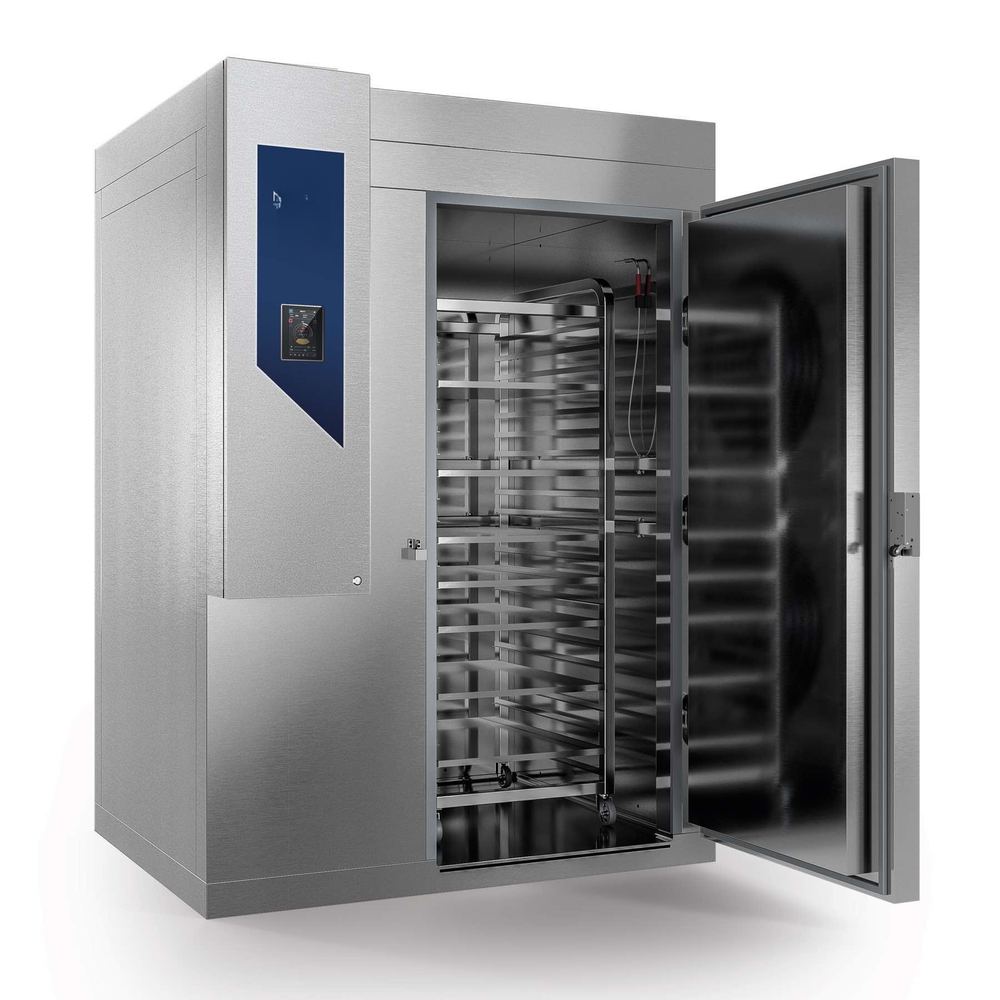
A blast freezer is not a colder version of a storage freezer — it does a different job. A holding freezer keeps already-frozen product at −18 to −25 °C. A blast freezer takes warm, fresh product and pulls it through the danger zone to a −18 °C core fast enough to protect texture, drip loss and shelf life. It does that with very cold air (−35 to −40 °C) moving at high velocity (3–8 m/s) across the product. Get the freezing rate wrong and you lose quality in the product and money in energy. This page is about specifying that stage correctly — and getting a price for it.
For the full conceptual explainer — the physics, the blast-freezer-vs-blast-chiller distinction, and the common mistakes — see our blast freezer vs blast chiller guide. Below is the commercial picture: formats, applications, sizing and cost.
Three formats — pick by product and volume
| Format | Best for | Throughput |
|---|---|---|
| Trolley blast cell | Seekh kabab, cuts, bakery, smaller lines | 0.5–1.5 t/batch |
| Batch blast room | Poultry, meat, ice cream, fruit pulp | 2–10 t/day |
| IQF tunnel | Prawns, peas, diced fruit — free-flowing pieces | Continuous, high volume |
A batch room or trolley cell freezes a fixed load over a cycle; an IQF (Individually Quick Frozen) tunnel runs a continuous belt so each small piece freezes separately without clumping. IQF gives the best individual-piece quality and the highest throughput, at the highest capital cost.
What we blast-freeze in Pakistan
- Poultry & meat — whole birds, cuts, mince and seekh kabab. A 1,000–1,500 kg poultry batch frozen to core in a single shift is a configuration we deliver regularly. See meat & poultry cold storage for the full plant.
- Ice cream & frozen desserts — hardening rooms and blast cells that take product from the freezer barrel down to a stable −25 °C core.
- Seafood & prawns — export-grade blast and IQF, with the validated logging buyers require.
- Fruit pulp & IQF vegetables — mango pulp, diced fruit, peas — frozen fast to lock in quality for the export season.
- QSR central kitchens & bakeries — blast chilling of cooked food (+70 → +3 °C in under 90 minutes) and freezing of par-baked product. Also covers thawing-room scope for QSR chains.
Sizing — it's about throughput, not room size
The fundamental sizing question for a blast freezer is not "how big is the room" — it's "how many tonnes per day (or kg per batch) do you need to freeze, from what entering temperature, in what cycle time?" The refrigeration load is dominated by the heat you have to pull out of warm product within the cycle, which is far higher than a holding store of the same volume.
- Batch load — kg of product per cycle and its entering temperature set the peak refrigeration demand.
- Cycle time — typically 4–8 hours to a −18 °C core, driven by product mass, shape and packaging. Shorter cycles need proportionally more refrigeration.
- Daily throughput — batches × shifts. A 5 t/day operation may need 3 cycles per shift, which sizes both the blast capacity and the downstream holding store.
- Air velocity & distribution — high-velocity evaporators and a baffled airflow path so every trolley sees the same freezing rate.
Run your numbers through our heat load calculator and condenser sizer for an engineering estimate, or get a budget figure from the cost calculator — all Pakistan-tuned and free.
What a blast freezer costs in Pakistan
| System | Throughput | Indicative price |
|---|---|---|
| Trolley blast cell | 0.5–1 t/batch | PKR 6–12 m |
| Batch blast room | 2–5 t/day | PKR 15–40 m |
| IQF tunnel | Continuous | PKR 60 m+ |
Final cost depends on throughput, refrigerant, and whether the blast stage integrates with an existing plant. See the cold storage cost buyer's guide for the full breakdown.
Reference work
- Industrial blast freezer — Lahore. 1,800 m³ at −35 °C for processed-poultry export.
- Gourmet ice-cream plant. Glycol-ammonia hardening and blast capacity for industrial ice cream and IQF — see the project.
- Multiple poultry and seekh-kabab blast cells across Punjab.
Frequently asked questions
What is a blast freezer and how is it different from a normal freezer?
A blast freezer rapidly freezes product by blowing air at −35 to −40 °C across it at high velocity (3–8 m/s), pulling fresh product from warm to a −18 °C core in 4–8 hours. A normal freezer room only holds already-frozen product at −18 to −25 °C — it cannot freeze warm product fast enough to protect quality. You blast-freeze, then move product to a holding freezer.
How is a blast freezer sized — by room size or by throughput?
By throughput, not volume. The right question is tonnes per day (or kg per batch) you need to freeze, the entering and target temperatures, and the cycle time. A 1,000–1,500 kg poultry batch frozen in 6–8 hours needs a very different refrigeration load than the same room used for slow holding. Sizing on room volume alone is the most common and most expensive scoping mistake.
What temperature does a blast freezer run at?
Air temperature is typically −35 to −40 °C for blast freezing. The product target is a −18 °C core. IQF tunnels for small/individual pieces (prawns, peas, diced fruit) run at the colder end. A blast chiller — the food-safety cousin — instead pulls cooked food from +70 °C down to +3 °C in under 90 minutes without freezing it.
What blast-freezing applications do you build in Pakistan?
Poultry and meat (whole birds, cuts, seekh kabab, mince), ice cream and frozen desserts, seafood and prawns for export, fruit pulp and IQF vegetables, par-baked bakery, and QSR central-kitchen prep. We build batch rooms, trolley blast cells, and continuous IQF tunnels depending on product and volume.
How much does a blast freezer cost in Pakistan?
A small trolley blast cell (0.5–1 t/batch) typically lands at PKR 6–12 million. A mid-size batch blast room (2–5 t/day) runs PKR 15–40 million. A continuous IQF tunnel is a larger capital item, PKR 60 million and up depending on belt width and throughput. Final cost depends on throughput, refrigerant, and whether it integrates with an existing plant. Use our cost calculator for a tuned estimate.
Can a blast freezer be added to my existing cold store?
Yes. A blast cell or room is frequently added alongside an existing holding freezer, sometimes sharing a multiplexed condensing rack with heat-recovery. We design the blast stage as a high-load zone with its own evaporators and air handling, feeding finished product straight into your holding store. We can integrate with your current refrigeration or supply a standalone package.
What is the difference between a blast freezer and an IQF tunnel?
A batch blast freezer freezes a fixed load (trolleys or stacked product) in a sealed cell over a cycle. An IQF (Individually Quick Frozen) tunnel runs a continuous belt so each small piece freezes separately without clumping — ideal for prawns, peas, diced fruit and similar free-flowing product. IQF gives higher throughput and a better-quality individual product, at higher capital cost.
Get a budget figure for your blast freezer in 10 seconds.
World's first intelligent cold store cost calculator. Pakistan-tuned across 12 cities and 24 commodities.
Open the cost calculator →