
Industrial refrigeration on ammonia and glycol.
For industrial refrigeration we provide screw or piston compressors operating on ammonia (NH₃), R404A, R507 or CO₂, with glycol and alcohol as intermediate fluids. All plant is operated by PLC with computerised supervision. Above roughly 500 kW this is the architecture that wins on lifetime energy cost at Pakistan's 46–50 °C summer ambient.
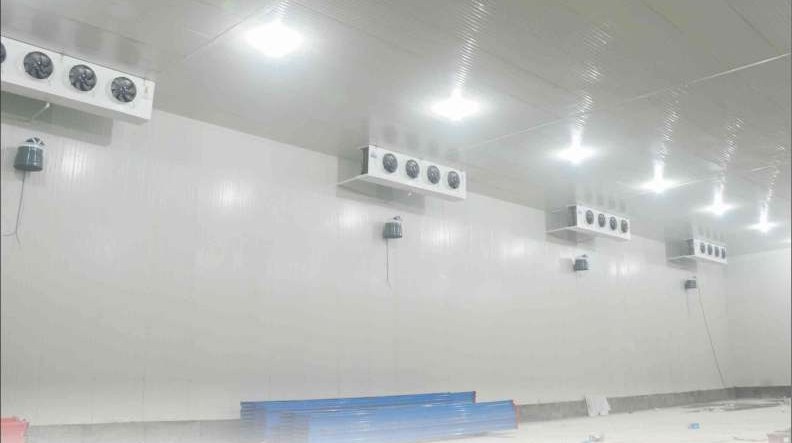
The plant
Industrial refrigeration is built around screw or piston compressors. These operate with ammonia, R404A, R507 and CO₂, with glycol and alcohol used as intermediate fluids in the secondary circuit. Our refrigeration design team sizes the plant for reduced energy consumption and guarantees smooth operation under correct maintenance — the two things that decide whether a store is still economic in year fifteen.
Why indirect glycol-ammonia
Ammonia is the most thermodynamically efficient refrigerant available and it is free. What it is not is something you want distributed in quantity through an occupied building. An indirect glycol-ammonia design confines the ammonia charge to a compact plant room and circulates chilled glycol to the rooms, which is the practical route to NH₃ efficiency on sites where a large distributed charge is not acceptable — food plants, logistics facilities, anywhere with people working alongside the stores.
The trade is a few degrees of approach temperature against a far smaller charge, a shorter pipe inventory of ammonia, and a plant room that a technician can be trained to work in safely.
Controls and supervision
All equipment is operated by PLC with computerised supervision, which is what makes economical and optimised management possible rather than aspirational. Operating times, temperatures, priorities and alarms are held centrally, and the plant runs to a schedule rather than to whoever is on shift.
Reference — HAC Agri, 3,000 ton
Our largest ammonia-glycol design is the HAC Agri installation: an ammonia glycol refrigeration design for a 3,000-ton controlled atmosphere store, twenty rooms in two banks off a central corridor, with sorting and receiving areas, blast chillers, a dedicated control room and plant room. Zanotti equipment with stainless-steel plate evaporators for glycol-solution cooling.
Where it sits
Above roughly 500 kW, ammonia or ammonia-glycol is the answer. Between 200 and 500 kW the economics usually favour a rack system; below 200 kW a CDU pack. All three are covered under industrial & commercial refrigeration.
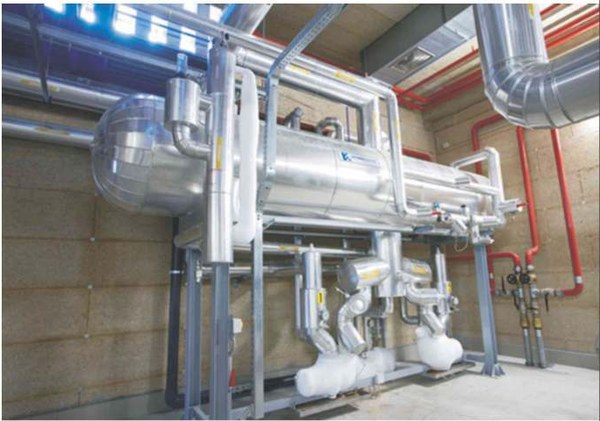
Sizing the plant for a 46–50 °C ambient
Most published condenser capacities are quoted at European design ambients. Pakistan does not run at those, and the gap is not a rounding error. Our condenser sizing applies a measured ambient derate of 2.0% per Kelvin for medium temperature and 2.7% per Kelvin for low temperature, with a hard floor at 60% of nameplate. On a Multan summer design day, a low-temperature condenser selected at a European ambient can be delivering little more than half the capacity on its label — which is how a plant that passed its factory test fails to hold −25 °C in June.
The same applies to the load side. A freezer at −25 °C carries an infiltration buoyancy factor of 1.45 against 1.0 for a cooler, rising to 1.55 at −30 °C and below: colder rooms pull air harder through every door opening, so door discipline and curtain choice move the load more than most operators expect. A strip curtain, correctly fitted, is worth a 0.10 protection factor — a 90% reduction in infiltration — against 0.50 for an air curtain.
The glycol circuit
An indirect design buys safety and charge reduction, and pays for it in two places. First, the secondary loop adds an approach temperature: the plant has to make glycol colder than the room needs, so the compressors run at a lower suction than a direct-expansion system would. Second, the glycol pumps consume power continuously whether the compressors are loaded or not.
Both are designable. Pump power comes down with correct pipe sizing and variable-speed pumping; the approach comes down with correctly selected plate evaporators — the reason the HAC Agri plant uses stainless-steel plate evaporators for glycol-solution cooling rather than a shell-and-tube compromise. Glycol concentration is set by the lowest circuit temperature with a margin, not by habit: over-concentrating raises viscosity, which raises pump power for no thermal benefit.
Where the ammonia charge sits
The engineering point of indirect is inventory. In a direct-expansion ammonia system the refrigerant travels to every evaporator in every room, so the charge is distributed through occupied space. In an indirect glycol design the ammonia is confined to the plant room — a single space that can be ventilated, gas-detected, alarmed and access-controlled as one problem rather than twenty. The circulating fluid in the building is glycol, which is not a hazard to product or people.
That is why indirect is the standard choice on occupied food and logistics sites, and why it is usually the design that gets approved without argument.
Run the numbers before you brief us
You do not have to take any of this on trust. Our cold room heat-load calculator runs the full ASHRAE Chapter 24 five-component method — transmission, infiltration, product pull-down, internal gains and safety factor — with 12 Pakistani cities and their real design ambients. The condenser sizer applies the derate above so you can see what a nameplate is worth on your site in July, and the refrigerant charge estimator uses NIST saturated-liquid densities. All free, no email required.
Questions buyers ask.
The technical and commercial questions we hear most often before a contract is signed.
01Is ammonia safe to use in a food facility?
02When does ammonia beat HFC on cost?
03Who services an ammonia plant in Pakistan?
04What refrigerants can the plant run?
Want a rough cost estimate? Sales-engineer tool, ±20% band.
Sales-engineer tool that combines sizing with cost output. Editable Izhar margin line. Pakistan-tuned across 12 cities and 24 commodities — size an industrial store and see an indicative build cost before anyone quotes it.
Open the rough estimator →